
Ah, discussion boards. Those remnants of the late nineties and early aughts. Often, they were graphically clunky, slow to load, and a strain on whatever web server hosted them, so it’s not surprising they fell to the wayside with the rise of social media. Bring in tools like Discord and Slack, and why bother?
Discussion Boards
For those whose brains are a little younger, discussion boards (aka internet forums or message boards) are websites where people can hold conversations in the form of longer posted messages. A single board might contain a multitude of topics and is made up of sub-forums, threads, and individual posts.
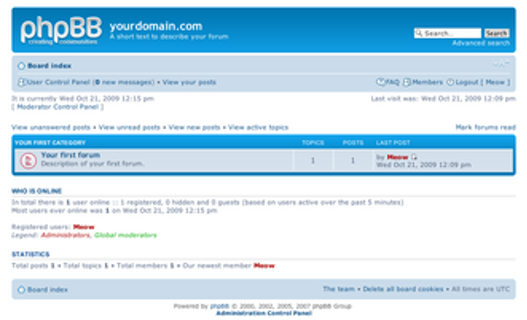
The image to the left is an example of a phpBB discussion board.
PhpBB and vBulletin were two common programs used to run discussion boards during their heyday, each with their own built-in options and settings.
So why bring back these ancient relics when we have new tools at our fingertips?
Reason #1: Not Chat Rooms
Reason #1 that discussion boards should make a comeback is that they aren’t chat rooms. Unlike DM’s and other chat methods, discussion board messages don’t have a length limit and they don’t disappear when you close the window like some chat clients do. Discussion boards allow for the archival of messages and are easily searchable, so if you need to find something quickly, you can.
In tools like Discord, a comment can scroll off the page quickly, easily missed and forgotten. This makes it hard to keep up with the conversation, let alone find it later when needed. Discord is also notoriously difficult to search, which isn’t a problem on a discussion board.
Reason #2: Easier to Moderate
Reason #2 might be debatable for some folks but most administrators and moderators find discussion boards easier to moderate. With fast scrolling content, it’s challenging to catch an offensive or hateful post before it’s done damage to viewers and readers. By then, the damage is done.
With discussion boards, you can flag certain words or topics to require moderator approval. Then the flagged post or thread doesn’t isn’t visible until a moderator takes a look at it. While some false-positives might get caught, a good moderation team can ensure that the right posts go through with the click of a button.
Reason #3: Organization
Reason #3 that discussion boards should make a comeback is their organization. Their taxonomy is well-structured and makes it simpler for people to find what they’re looking for.
For example, on a forum or discussion board for animal lovers, there might be sub-forums for specific animals, such as one for cat lovers. Under this sub-forum, a user would find people’s threads or posts about a cat-loving topic. Perhaps a user posts a thread asking whether or not crystal cat litter is better than clay cat litter. Under this thread, people would chat on the topic, their comments neatly stored in chronological order. Replies would be easy to find without having to scroll through a lot of off-topic chatter first, which often happens on Discord and other chat-based clients.
Reason #4: Password Controlled
For a time, many schools used discussion boards because it allowed students to chat about classroom topics in an organized, searchable manner that was easily moderated. Because a discussion board or even sub-forums themselves could be password protected, the information could be kept from the prying eyes of those not in the class—a handy tool for discussing this year’s semester exam while keeping next semester’s students from seeing the answers.
Being able to lock certain areas while other areas were open lent itself well to more than schools. Businesses, HOAs, and even churches used such tools to control the method and means of information’s availability.
Reason #5: Open-Sourced Flexibility
Probably the most important reason that discussion boards should make a comeback is that the software is open-sourced, meaning that it is free and editable. Hosting the program on a website isn’t free—you still have to pay for your website’s domain and host—but you could install something like phpBB on that hosted site for free.
Being open-sourced also means there are tons of plug-ins and add-ons one can install to customize the base discussion board, or if one is a programmer, you can write or code your own.
This makes discussion boards easy for businesses, fan clubs, and so on to use because you don’t have to pay a monthly fee for the app or program. You don’t have to pay fees to add cute emojis (I’m looking at you, Discord Nitro). Add-ons aside, the base programs themselves come complete with plenty of options such as changing the look and feel of the board, creating polls, user notifications, and even subscription areas.
While chat-based tools have a purpose, discussion boards have lasting power that make them a better choice for those wanting a place to share information.
